|
|
||||
Dear All:
Greetings again from Singapore, where I continue my work as lecturer in liturgy
and worship (and chaplain) at Trinity Theological College. We have just
completed the first semester of the 2012-2013 academic year and are looking
ahead to the second semester. Our current "school holiday" runs until Monday, 7
January.
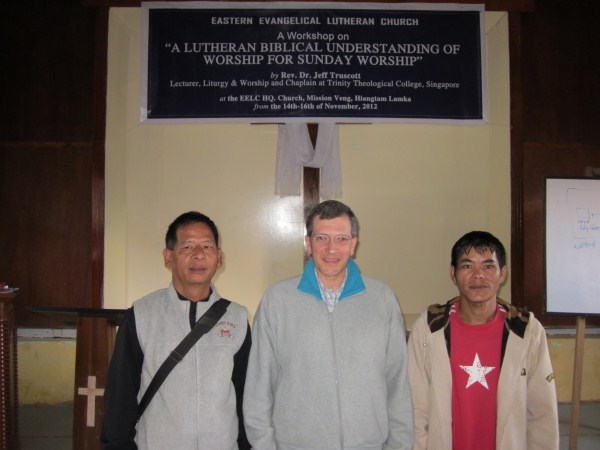
From November 14 to 21 I was in Manipur, India, teaching Lutherans there about worship. Specifically, I gave three presentations to leaders of the Eastern Evangelical Lutheran Church (EELC) from 14 to 16 November, and then I presented much of the same material to pastors and lay leaders of the Manipur Evangelical Lutheran Church (MELC) on 19 and 20 November. (It was necessary to repeat the material because the two churches use different languages.) The trip was arranged through the Global Mission Unit of the ELCA in Chicago, which is in conversation with EELC and MELC about how we might accompany them in their continuing theological and organizational development.
Having never been to India and experiencing its conditions of poverty, poor sanitation, and lack of infrastructure, I found this to be a time of great awareness-raising and perhaps sorrow. But the warm and gracious hospitality of my hosts, EELC President Rev. John Hauzel and Pr. Benson Lian and his mother, Deaconess Niangzachiin, overcame and transcended what westerners would perceive as lackings in the social and physical environment.
The state of Manipur is located in the extreme northeast of India and borders on the country of Myanmar (Burma). It is referred to as a "tribal" region, along with its neighboring states of Nagaland, Assam, and Misoram. The word "tribal" is not meant in a pejorative sense or to belittle the people. Rather it is meant to distinguish them from the majority of Hindi and Tamil peoples who adhere to Hinduism. The culture and languages of tribal peoples are very different from those of people living in the rest of India. While the latter write using ancient script (e.g. Sanskrit), the tribal languages are written using the Western European alphabet, which was developed by nineteenth-century missionaries.
But the majority of people in tribal states are Christians because missionaries to India found that region more receptive to Christianity – mainly because the people were originally "animists" or nature worshippers, rather than followers of the ancient and well-established Hindu religion. Most tribal people are either Baptists or Presbyterians, with Methodists, Lutherans and Roman Catholics making up smaller percentages of the Christian population. The influence of Presbyterianism is very evident in both EELC and MELC, with leaders being referred to as "elders" and "moderators," terms quite unknown among American and European Lutherans. But there is some degree of uncertainty as to what Lutheran "elders" and "moderators" should do, and what the whole ecclesiastical structure should look like. Indeed, because of the relative youth of these churches (EELC being established in 1979 by a lay leader) and because local multi-denominational seminaries are not strong in Lutheran theology and practice, Manipurian Lutherans are keen to discover what being Lutheran means, especially in terms of worship. In fact, I was very pleased at their eagerness to learn. In a day when many churches – Lutherans and otherwise – are thoughtlessly abandoning their liturgical traditions and even their theology in the name of "relevance," it was indeed gratifying to be among Christians who want to dig deeply into their Christian heritage and thereby discover their identity. Could we take a lesson from this as American Lutherans?
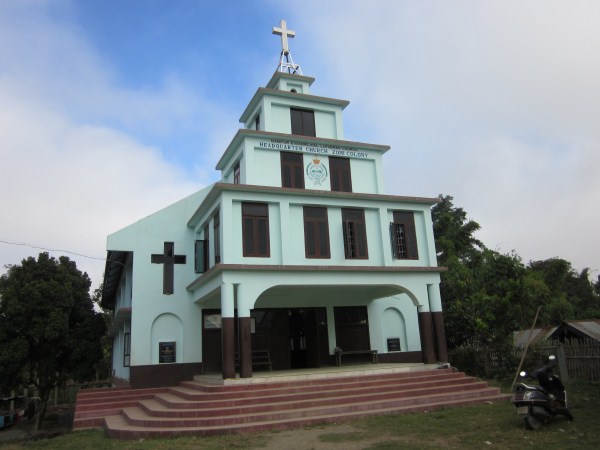
I have attached a few photos of this trip, including ones of myself and my host Pr Benson, taken from atop a Prayer Mountain, plus a scenic shot from that same locale. I have also included a shot of both the exterior and interior of the MELC church where I taught. Noteworthy is the arrangement of the chancel which reflects more of a Presbyterian influence. Finally, please note the photo of the drums used in the worship of the MELC church (similar to those used by EELC churches). Usually, only drums like these will accompany congregational singing in the worship of Indian "tribal" Christians.
Let me thank you once again for your support, which among other things, makes possible teaching trips like the one described above. I am sure that our friends in Manipur would also be grateful that your churches supports missionaries like me!
Best regards in Christ,
Jeff
Rev. Dr Jeffrey A. Truscott
Lecturer in Worship and Liturgy Chaplain
Trinity Theological College
490 Upper Bukit Timah Road
Singapore 678093